Blog
Cannabis and Breast Cancer: What the Research Actually Shows
Cannabis and Breast Cancer: What the Research Actually Shows
Cannabis and breast cancer research points to one clear use and a lot of open questions. Cannabinoids can help some people with chemotherapy nausea that standard drugs have not controlled. No human trial has shown that cannabis treats or slows breast cancer. For pain, sleep, and anxiety during treatment, the results are uncertain.
October is Breast Cancer Awareness Month, and the numbers explain why so many patients are asking. The National Cancer Institute’s SEER program estimates 321,910 new cases of invasive breast cancer in women in 2026, and about 13% of women will be diagnosed at some point in their lives. That is roughly 1 in 8.
How Many Breast Cancer Patients Use Cannabis?
More than many doctors realize. One of the largest surveys on cannabis and breast cancer, published online in 2021, asked 612 people diagnosed within the previous five years about their use. 42% said they had used cannabis to relieve symptoms. The most common reasons were pain (78%), insomnia (70%), anxiety (57%), stress (51%), and nausea or vomiting (46%).
Of the people using cannabis, 79% used it during active treatment, including chemotherapy, radiation, and surgery. Only 39% had talked about it with any of their physicians. And 49% believed cannabis could treat the cancer itself, a belief the research does not support.
What Do Cancer Experts Say About Cannabis and Breast Cancer?
The American Society of Clinical Oncology’s 2024 guideline on cannabis and cannabinoids in adults with cancer reviewed 13 systematic reviews and five additional studies (four randomized trials and one cohort study). The panel rated the certainty of evidence for most outcomes as low or very low.
The guideline covers all cancers, so it applies directly to cannabis and breast cancer. Its main points:
- Clinicians should recommend against using cannabis or cannabinoids to treat the cancer itself, except in a clinical trial.
- Cannabinoids may help chemotherapy nausea and vomiting that has not responded to standard anti-nausea drugs, when added to those drugs.
- Whether cannabis improves other symptoms, such as pain, sleep, appetite, or anxiety, remains uncertain.
The panel’s summary was blunt: use of cannabis by adults with cancer “has outpaced the science supporting their clinical use.”
Can Cannabis Treat or Slow Breast Cancer?
Not based on current evidence. The National Cancer Institute’s cannabis summary notes that the FDA has not approved cannabis or cannabinoids as a cancer treatment.
Much of the hope around cannabis and breast cancer comes from lab and animal studies, where THC and CBD have affected cancer cells. That does not show what happens in a person. A 2023 review on triple-negative breast cancer found that some lab studies showed anti-tumor activity, others suggested cannabinoids might promote tumor growth, and clinical studies in patients are few.
Choosing cannabis oil instead of proven treatment can cost time that matters.
Does Cannabis Help With Chemotherapy Nausea?
 For cannabis and breast cancer care, this is the strongest area of evidence. Two cannabinoid drugs, dronabinol and nabilone, are FDA-approved for nausea and vomiting caused by chemotherapy, according to the NCI.
A Cochrane review of 23 randomized trials found that people taking cannabinoids were more likely than those on placebo to have no vomiting at all. Compared with an older anti-nausea drug, prochlorperazine, there was no clear difference. People on cannabinoids were also more likely to drop out because of side effects and to report feeling high.
Those trials ran between 1975 and 1991, and none compared cannabinoids with modern anti-nausea drugs such as ondansetron. That is why ASCO treats them as an add-on when standard drugs fail. For appetite loss, see our article on cannabis and appetite.
What About Pain, Sleep, and Anxiety?
Pain was the top reason survey respondents gave, but trials in cancer pain have been disappointing.
A phase 3 trial of nabiximols, a mouth spray with roughly equal THC and CBD, enrolled 397 people with advanced cancer whose pain was not controlled by opioids. Median pain improved 10.7% with the spray and 4.5% with placebo, a difference that was not statistically significant on the main measure. A 2020 meta-analysis of six trials with 1,460 participants found that adding cannabinoids to opioids did not reduce pain in adults with advanced cancer.
Some people feel better, but trials have not shown a dependable effect. For pain after treatment ends, see our review of cannabis for chronic pain.
Cannabis and Breast Cancer Medications: The Tamoxifen Question
This is the part of cannabis and breast cancer that patients most often miss. Many breast cancer treatments are processed by liver enzymes that CBD and THC can affect.
Tamoxifen is the clearest example. The body converts it into endoxifen, the form that does most of the anti-cancer work, using enzymes called CYP2D6 and CYP3A4. CBD can slow those enzymes. In a published case report, a 58-year-old woman in remission, taking tamoxifen to prevent recurrence, also took 40 mg of CBD a day. After she stopped the CBD, her endoxifen level rose by 18.75%.
A 2023 study in npj Breast Cancer tested this directly. In patients on tamoxifen using CBD oil, endoxifen fell 12.6% but stayed within the range researchers count as equivalent. The authors concluded that good-quality CBD oil under 50 mg a day does not have to be discouraged for people using it for tamoxifen side effects.
The evidence on cannabis and breast cancer medications is still small, so tell your oncologist and pharmacist about any cannabis or CBD product before starting it. See our guides to medical cannabis and drug interactions and CBD vs. THC.’
 Does Breast Cancer Qualify for a Medical Cannabis Card?
CCOA serves patients in 27 states, and breast cancer may qualify in each. The rules differ.
Cancer is named on the qualifying list in Arizona, Arkansas, California, Connecticut, Delaware, Illinois, Massachusetts, Michigan, Missouri, Montana, Nevada, New Jersey, New York, Ohio, Oklahoma, Utah, Vermont, and West Virginia. Pennsylvania lists “cancer, including remission therapy,” and Texas covers all forms of cancer in its Compassionate Use Program.
Some states add conditions. In Iowa and Minnesota, the cancer or its treatment must cause symptoms such as severe pain, nausea, or wasting. Georgia‘s low-THC oil registry covers end-stage cancer or treatment that causes wasting or severe vomiting. Maryland qualifies patients by symptoms, including severe pain and severe nausea.
Louisiana, Maine, and Virginia have no fixed list. The certifying clinician decides whether cannabis fits your condition.
Check your state on our locations page. Certification is never automatic. See also our guide to medical cannabis in palliative care.
What to Bring to Your Evaluation
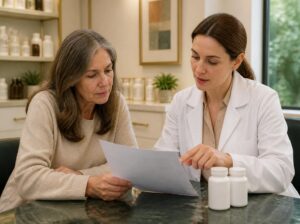 The safest approach to cannabis and breast cancer starts with your care team. Before an evaluation in any of our 27 states, gather:
- Your diagnosis, stage, and where you are in treatment.
- Every current medication, including tamoxifen, aromatase inhibitors, chemotherapy, and anti-nausea drugs.
- Any cannabis or CBD you already use, with the product, dose, and how often.
- The symptom you most want to improve, and how you will tell if it is working.
Our list of questions to ask a medical cannabis physician can help you prepare.
Cannabis and Breast Cancer FAQ’s
Can cannabis cure breast cancer?
No. No human trial has shown that cannabis treats or cures breast cancer. ASCO recommends against using it to treat cancer outside a clinical trial.
Is cannabis safe to use during chemotherapy?
Cannabinoids may help nausea that standard drugs have not controlled, but they can interact with some cancer medications. Talk to your oncologist before using any product during treatment.
Does CBD interact with tamoxifen?
It may. CBD can slow the enzymes that activate tamoxifen, though a 2023 study found the drop stayed within equivalence limits. Tell your oncologist and pharmacist if you use CBD.
Does breast cancer qualify for a medical cannabis card?
It may in all 27 states CCOA serves, but each state sets its own rules, and a licensed clinician must still complete an evaluation.
The Bottom Line
The honest summary of cannabis and breast cancer research is narrow. Cannabinoids have a real role for chemotherapy nausea that standard drugs have not controlled. They are not a cancer treatment. Evidence for other symptoms is uncertain.
If you or someone you love has breast cancer and wants to explore medical cannabis, start with your oncologist. Then check your state and begin an online evaluation. The evaluation does not guarantee certification or relief.
Medical and legal disclaimer: This article is for educational purposes only and does not provide medical or legal advice. Cannabis laws and program rules vary by state and change over time. Do not start, stop, or change cancer treatment or any prescribed medication without consulting your licensed care team. Cannabis can cause impairment and other adverse effects and is not appropriate for every person.