Blog
THC Cream for Arthritis
THC Cream for Arthritis
THC Cream for Arthritis
If you have stood in front of a shelf of cannabis topicals, reading the milligram numbers on the labels, comparing a 500 mg jar against a 1,000 mg jar and trying to work out which one is worth the money, you have already done more careful thinking about the product than most of the research behind it.
That sounds like an insult but it is a description of the evidence.
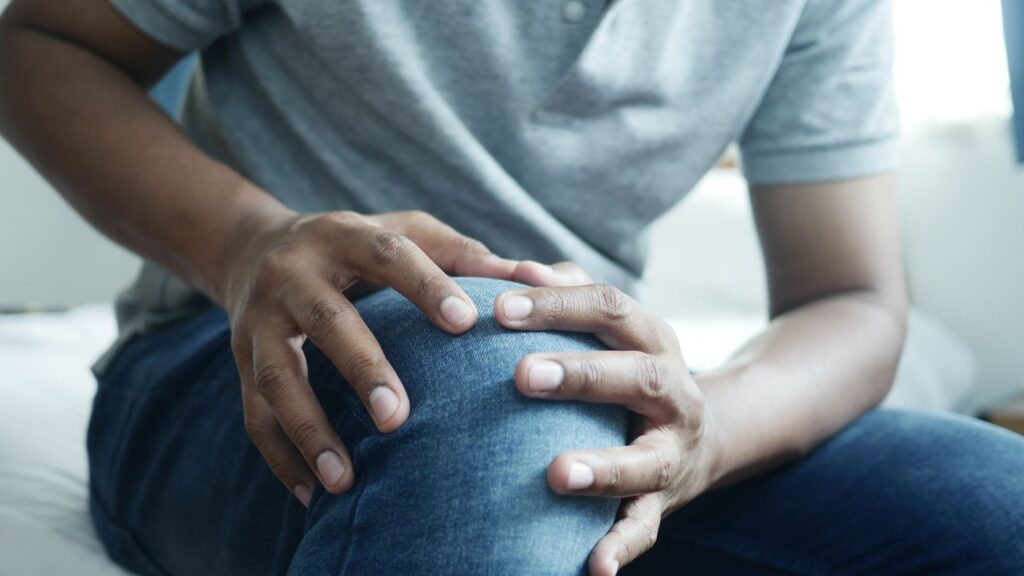
If you searched for a THC cream for arthritis, you are asking a fair question, and this is an attempt to answer it with what has actually been tested. Topical products are low risk. People do report that they help. Wanting to try one for a sore knee or a stiff hand is a reasonable thing to want, and nobody should feel foolish for it. What follows is an account of what has actually been measured, because the gap between what the labels imply and what anyone has tested is wider here than in almost any other corner of medical cannabis.
Does THC Cream Help With Arthritis?
The honest answer has three parts. There is one human trial of a topical THC product in joint pain. It was not designed to measure whether the product works. And it did not study arthritis.
The trial was published in Cannabis and Cannabinoid Research in 2026. Twenty-one women completed it, all of them with stage 1 to 3 breast cancer, all of them taking aromatase inhibitors, a class of drug commonly causing joint pain and stiffness as a side effect. The condition has its own name, aromatase inhibitor-associated musculoskeletal syndrome, and nearly two thirds of women on these drugs develop it.
Osteoarthritis and rheumatoid arthritis are different diseases with different mechanisms, and neither is what this trial studied.
The women were randomly assigned to a CBD balm or a THC balm, applied to the hands three times daily for two weeks. The trial was open-label, meaning everyone knew which balm they had received, and there was no placebo group at all. Its stated purpose was to find out whether a trial like this could be run using products bought from state-approved dispensaries, and whether the balms were tolerable.
On those questions it succeeded. Compliance was high and both balms were well tolerated. One participant discontinued because the balm was greasy, and minor skin irritation affected 24 percent.
Across both arms, 86 percent of participants reported some improvement. Within that, and again in an open-label design with no placebo arm, 50 percent of the THC group reported improvement greater than 50 percent, against 18 percent of the CBD group.
Read that comparison with the design attached. Every participant knew which cannabinoid she had been given. Nearly half had never used cannabis in their lives. In that situation, expectation and the simple fact of being in a study are not background noise. They are plausible explanations for the entire difference.
The authors say so themselves. Their conclusion is that conducting such a trial is feasible, that both balms are well tolerated, and that placebo-controlled trials are needed to determine if balms can reduce AIMSS severity.
That is the complete human evidence base for the phrase you searched.
What a Federal Review Says About Topical Cannabis
If you wanted an independent audit of everything published on cannabis and chronic pain, updated every year rather than written once and left to age, it already exists. The Agency for Healthcare Research and Quality maintains a living systematic review of cannabis and other plant-based treatments for chronic pain. Its 2025 update, led by Roger Chou and colleagues, searched five research databases through 28 April 2025. From 6,304 abstracts screened since the review began, 29 randomized controlled trials covering 2,579 patients and 15 observational studies covering 49,453 people met the standard for inclusion.
On topical cannabinoids, the review’s verdict is one word. Evidence on whole-plant cannabis, topical CBD, and other cannabinoids, it reports, “remained insufficient.”
Notice what the review does not do. It does not assess topical THC and reach a negative verdict. It does not assess topical THC at all, because there was not enough to assess. Its search closed in April 2025, a year before the AIMSS trial appeared, and even then there was nothing topical and THC to review.
The review has plenty to say about cannabis taken by other routes, and those findings are worth knowing even though they cannot be transferred to a cream. Synthetic or purified oral CBD on its own was not associated with reduced pain intensity across four trials and 334 patients, a finding graded by the reviewers at moderate strength of evidence, as close to settled as this field gets. Extracted products with comparable THC and CBD content, given as an oral spray, produced a small reduction in pain severity. Improvement in function fell below the threshold the reviewers set for even a small effect.
The harms came through more clearly than the benefits. For that same oral spray, the risk of dizziness rose more than threefold and the risk of sedation more than fivefold. For synthetic and purified high-THC products, withdrawals due to adverse events rose, and so did dizziness and nausea. The reviewers also note that evidence was simply not available on some of the harms that matter most, including psychosis, cannabis use disorder, and cognitive effects.
Every one of those numbers describes cannabis swallowed, sprayed or inhaled. None of them describes a cream, and none of them should be quoted at you as though it did.
Why Getting THC Through Skin Is Tough
There is a reason the shelf is full and the literature is empty, the answer is chemistry. Skin is a barrier. Its outer layer is built to stop fat-soluble molecules. Cannabinoids are exactly that.
The most direct measurement available compared three cannabinoids across human skin tissue in the laboratory. It found that CBD and cannabinol crossed skin roughly ten times more easily than the delta-8 form of THC. Adding ethanol at 30 to 33 percent significantly increased how much got through. The carrier, meaning the cream or gel formula itself, matters, and the studies keep finding it matters a great deal.
Two limits on that finding. The THC molecule tested was delta-8, not the delta-9-THC in a dispensary product. And the work was done on skin tissue in a laboratory rather than on a living person. It is the most direct human-skin comparison available, and it is still not the same thing as measuring what reaches an inflamed joint.
Work on delta-9-THC points the same way. A 2022 pharmaceutical study found delta-9-THC to be highly fat-soluble and vulnerable to breaking down under heat and oxygen, so unstable in its pure form that the researchers had to dissolve it in engineered lipid systems and add antioxidants before they could get consistent penetration and keep the compound intact.
An entire research subfield exists on how to enhance cannabinoid penetration through skin. Reviews are published on permeation-enhancing strategies and on improving cannabinoid bioavailability, two of them in 2024 alone. Nobody builds a body of literature around how to do an easy thing.
The Two Studies That Found Something
Two trials of topical CBD in arthritic joints did report positive results, and both are smaller than the confidence of the shelf would suggest.
The first, published in The Journal of Hand Surgery in 2022, studied thumb basal joint arthritis. Eighteen participants were randomized to two weeks of twice-daily topical CBD in shea butter or to shea butter alone, then crossed over to the other after a one-week washout. It was double-blinded, and the design is the part worth praising. Testing a cannabinoid cream against its own vehicle, rather than against nothing, is good design, and it is more rigorous than most of what surrounds this topic.
Patient-reported outcomes improved during the CBD treatment period across pain scores, a disability questionnaire, and a self-assessment measure. No adverse events occurred. Range of motion, grip strength and pinch strength were similar between the two treatment periods.
The second, published in Scientific Reports in 2024, studied hand osteoarthritis using a 4 percent transdermal CBD gel applied three times daily for four weeks. Eighteen people enrolled and fifteen finished. Current, average and maximum pain all fell by about 1.9 points on a 0 to 10 scale. Grip strength in the treated hand increased. Self-reported functionality did not improve. Fatigue, stiffness and anxiety ratings did. CBD and its breakdown products turned up at low concentrations in every urine sample, a useful finding in its own right and one returned to below. When treatment stopped, the measures drifted back toward where they started, which is the one result in that trial arguing against pure expectation.
This trial had no placebo group and no control arm of any kind. Everyone knew they were receiving CBD. The authors are direct about what that means. Proof of efficacy, they write, requires further confirmation in a placebo-controlled randomized trial. The word “further” is theirs, and what they call for is the trial nobody has run.
In the thumb trial the split is clean. Every measure depending on how the patient felt improved. Every measure taken with an instrument, range of motion, grip and pinch strength, did not. We saw the same split in systemic CBD when we reviewed CBD for inflammation.
The hand gel trial reverses it in both directions, as reported above. So this is a pattern in one trial and a partial reversal in the other, which is about what you would expect from two studies of eighteen and fifteen people.
The Same Number, With and Without a Control Group
Consider two results side by side. In the hand osteoarthritis trial above, pain fell by 1.9 points on an 11-point scale, in a study with no placebo arm.
Now take a phase 3 randomized controlled trial of 820 patients with chronic low back pain, published in *Nature Medicine* in 2025 and covered in detail in our piece on cannabis for back pain. In that study, pain in the cannabis group also fell by 1.9 points on an 11-point scale. But because the trial had a placebo group, the researchers could see something beyond the reach of the hand study. The margin over placebo was 0.6 points. The placebo arm had fallen by roughly 1.3 points on its own, which means about two thirds of what those patients felt happened in both groups.
The same number. The difference that decides what the number means is whether anyone was measuring against a control.
This does not prove the hand gel was placebo. It cannot, and claiming otherwise would be the same overreach in the opposite direction. What it shows is narrower and more useful. A pain reduction of 1.9 points, reported on its own, carries almost no information about whether a treatment did anything. The study design is what decides whether a number means something.
Which Is Better for Arthritis Pain, CBD or THC?
No trial with a placebo arm has ever compared them head to head. The AIMSS study randomized women between a CBD balm and a THC balm, but it was open-label and powered for feasibility, so it cannot settle the question and does not claim to.
It is worth knowing what a properly powered trial in this field looks like, because one exists. In 2022 a Danish team gave 136 patients with hand osteoarthritis or psoriatic arthritis either synthetic CBD or a placebo for twelve weeks, double-blind. The difference in pain between the two groups at the end was 0.23 millimeters on a 100-millimeter scale. That trial was oral, not topical, so it settles nothing about creams. It does show that this field can produce a clean answer when someone builds a study capable of giving one.
What can be said usefully is not about which molecule wins. It is about three real differences.
Access is the largest. CBD topicals derived from hemp are sold over the counter in most of the country, in pharmacies, supermarkets and online. THC topicals are cannabis products, sold through licensed dispensaries, and in states with medical programs they require a certification from a qualified physician before you can legally buy one. If you searched for a THC cream, that is the practical answer to how you would obtain it. You can see if you qualify for an evaluation.
Chemistry is second. The laboratory work on skin penetration suggests the two molecules do not cross skin equally well, and that the form tested there, delta-8-THC, crossed considerably less readily than CBD did.
Regulation is third, and it is the subject of the next section.
What we will not do is tell you which product to buy, name a brand, or recommend a ratio. Nobody has the evidence to make that call honestly; implying otherwise is a sales move, not medicine.
What Is Actually in the Jar
Set aside the question of whether the molecule works. There is a prior question, and you can act on this one. Does the product contain what the label says?
A 2022 analysis in the Journal of Cannabis Research tested 80 commercially available hemp-derived CBD products bought from online and local retailers. Thirty-seven of the 80 differed from their label claim by at least 10 percent. Twelve contained less than 90 percent of what was stated. Twenty-five contained more than 110 percent. Products landing within a 10 percent tolerance of their own label came to 54 percent of the sample.
A separate 2022 study examined 13 over-the-counter products and reached a similar conclusion, noting that most showed apparent distinctions between their true and labelled contents. That study also tested penetration in a pig skin model. What it found reframes the whole shelf. How much crossed the skin tracked with particle size and formulation stability, and was not directly related to the CBD content. The milligram number on the front does not decide how much reaches the tissue.
Both studies tested unregulated hemp-derived CBD products. Neither tested dispensary THC topicals. Those are sold under state testing and labelling requirements that unregulated hemp CBD products largely avoid. The mislabelling finding is real and it is specific. Do not extend it to a dispensary product, and do not let anyone extend it for you.
The Trial That Worked Using Seeds
The largest and longest of the topical trials on this page is also the strangest, and it is genuinely useful for understanding why “cannabis” on a label tells you so little.
Ninety patients with knee osteoarthritis were randomized, double-blind, into three groups: topical hemp seed oil, diclofenac gel (an anti-inflammatory drug), and placebo, applied daily for two months, with assessments at four and eight weeks. The one measure taken with an instrument rather than reported by the patient, how far the heel could be drawn to the thigh, showed no difference between any of the three groups. The hemp seed oil group improved significantly against placebo on pain scores and on a standard osteoarthritis index, and they were about as strong as the anti-inflammatory gel group’s, a comparison thirty patients per arm cannot settle either way.
On the face of it, that is the most impressive result on this page. It ran longer than the others, enrolled more patients, and included an active drug comparator rather than only a placebo.
Then you look at what was in the bottle. Hemp seed oil is pressed from the seeds of the plant, not from the flower. A 2019 analysis of ten commercial organic hemp seed oils profiled their cannabinoid content. Alongside THC and CBD, the researchers identified thirty further cannabinoids in hemp seed oil for the first time, and found wide variation in composition, and specifically in cannabinoid content, between the oils tested. Content depended on the manufacturing method and the plant variety.
So the trial cannot tell you that a cannabinoid did the work. It cannot tell you which cannabinoid, or how much of it, because the product category varies substantially bottle to bottle. The AHRQ reviewers assessed this same trial and still classified the overall evidence in this area as insufficient.
A single word on a label spans chemistry that is not the same chemistry, and a positive result for one cannabis-derived product says almost nothing about a different one.
Do THC Topicals Really Work for Pain?
When the only human trial of the product you searched for enrolled 21 people, ran without a placebo group, and studied a condition caused by a breast cancer drug, the useful question stops being whether the cream works and becomes what you can reasonably expect from it.
Nobody has run the trial that would answer the first question. The two positive topical CBD studies involved 18 and 15 people, and only one of them had a control arm of any kind. The most authoritative independent review of this literature calls the evidence insufficient, and the strongest single human-skin measurement available found the delta-8 form of THC crossed roughly ten times less readily than CBD did.
In rats with induced arthritis, a CBD gel applied to the skin reduced inflammation and pain behavior, and it does so in a dose-dependent way, which is why the interest exists at all. That work is a reason to run human trials. It is not a substitute for having run them, and the doses involved bear no relationship to a jar on a shelf.
None of this adds up to “do not bother.” Topicals are low risk, and the decision to try one is a small decision. If it helps you, that experience is yours and no trial overrides it, and how cannabis changes the experience of pain is a real question we have looked at elsewhere.
The narrower point is that nobody can honestly quote you an expected effect size, because none has been measured under conditions that would produce a trustworthy one. And a cream cannot act on a process happening deep inside a joint if the active compound does not reach it. For a cannabinoid cream, with no measurement of what reaches the joint, comfort at the surface is the expectation the evidence supports.
Arthritis can progress. If a product makes a joint feel better while the damage underneath continues, the relief is real and the situation has still changed. Someone needs to be tracking the joint itself, not only the symptom. That is the argument for having a physician in the loop rather than managing this alone at the shelf. If you want a physician’s read on whether cannabis fits your current treatment plan, you can start with an evaluation.

Common Questions
Does THC cream get you high?
Topical products are generally described as acting locally without producing intoxication, and that appears to be broadly true, but “nothing is absorbed” overstates it. In the hand osteoarthritis trial of a transdermal CBD gel, CBD and its metabolites were detected at low concentrations in every urine sample collected. Something crossed. How much crosses from a THC product, and whether it is enough to matter for a drug test or for how you feel, has not been established in any study designed to measure it.
Do I need a certification to buy a THC cream?
In states with medical cannabis programs, yes. THC topicals are cannabis products sold through licensed dispensaries, and access requires a certification from a qualified physician. Over-the-counter hemp-derived CBD topicals do not.
Is arthritis a qualifying condition?
It depends on the state, and the answer changes as programs are updated. Some states list arthritis or specific forms of it directly. Others cover it through a broader chronic pain category. Some do neither. This is a question to answer for your own state rather than in general, and the fastest way to do that is to check whether your condition qualifies where you live.
Does weed help joint pain?
For cannabis taken by mouth or inhaled, the AHRQ review found small reductions in pain for some product types, mostly in studies of nerve pain rather than arthritis, alongside clear increases in dizziness, sedation and nausea. For cannabis applied to the skin, the evidence was classified as insufficient. Those are two different questions with two different answers, and the second one is the one most people are actually asking.
Will a stronger cream work better?
The available evidence does not support that assumption. In the pig skin study, how much cannabinoid crossed the skin barrier tracked with particle size and formulation stability rather than with the concentration on the label. A higher milligram figure describes what went into the jar, not what comes out of it.
Sources
1. Chou R, Ahmed A, Dana T, Morasco BJ, Bougatsos C, Fu R. Living Systematic Review on Cannabis and Other Plant-Based Treatments for Chronic Pain: 2025 Update. AHRQ Comparative Effectiveness Reviews, Report No. 25-EHC036. Agency for Healthcare Research and Quality (US), Rockville MD, July 2025. PMID 40956916.
2. A Randomized, Open-Label Trial to Assess Feasibility and Tolerability of Topical Cannabis Balms for the Treatment of Aromatase Inhibitor-Associated Musculoskeletal Syndrome (AIMSS). Cannabis and Cannabinoid Research, 2026. PMID 41467893.
3. Stinchcomb AL, Valiveti S, Hammell DC, Ramsey DR. Human skin permeation of Delta8-tetrahydrocannabinol, cannabidiol and cannabinol. Journal of Pharmacy and Pharmacology, 2004. PMID 15025853.
4. Effect of Lipid Vehicles on Solubility, Stability, and Topical Permeation of Delta-9-Tetrahydrocannabinol. AAPS PharmSciTech, 2022. PMID 35962264.
5. A Randomized Controlled Trial of Topical Cannabidiol for the Treatment of Thumb Basal Joint Arthritis. The Journal of Hand Surgery, 2022. PMID 35637038.
6. An open-label feasibility trial of transdermal cannabidiol for hand osteoarthritis. Scientific Reports, 2024. PMID 38783008.
7. Vela J, Dreyer L, Petersen KK, Arendt-Nielsen L, Duch KS, Kristensen S. Cannabidiol treatment in hand osteoarthritis and psoriatic arthritis: a randomized, double-blind, placebo-controlled trial. Pain, 2022;163(6):1206-1214. PMID 34510141.
8. Label accuracy of unregulated cannabidiol (CBD) products: measured concentration vs. label claim. Journal of Cannabis Research, 2022. PMID 35658956.
9. Quantification of Cannabis in Infused Consumer Products and Their Residues on Skin. ACS Pharmacology and Translational Science, 2022. PMID 35983282.
10. Effect of Topical Hemp (Cannabis sativa L.) Seed Oil on Knee Osteoarthritis: A Randomized Double-Blind Controlled Trial. Pain Management Nursing, 2025. PMID 39256070.
11. Cannabinoid Profiling of Hemp Seed Oil by Liquid Chromatography Coupled to High-Resolution Mass Spectrometry. Frontiers in Plant Science, 2019. PMID 30815007.
12. Hammell DC, Zhang LP, Ma F, et al. Transdermal cannabidiol reduces inflammation and pain-related behaviours in a rat model of arthritis. European Journal of Pain, 2016;20(6):936-948. PMID 26517407.
13. Phase 3 randomised controlled trial of cannabis extract for chronic low back pain. Nature Medicine, 2025. PMID 41023483.
14. Permeation-Enhancing Strategies for Transdermal Delivery of Cannabinoids. 2024. PMID 37751171.
15. Strategies to Improve Cannabidiol Bioavailability and Drug Delivery. 2024. PMID 38399459.