Blog
10 Big Benefits of a Medical Cannabis Certification in a Recreational Cannabis State
10 Big Benefits of a Medical Cannabis Certification in a Recreational Cannabis State
10 Big Benefits of a Medical Cannabis Certification in a Recreational Cannabis State
Is a Medical Card Worth It If Recreational Is Legal?
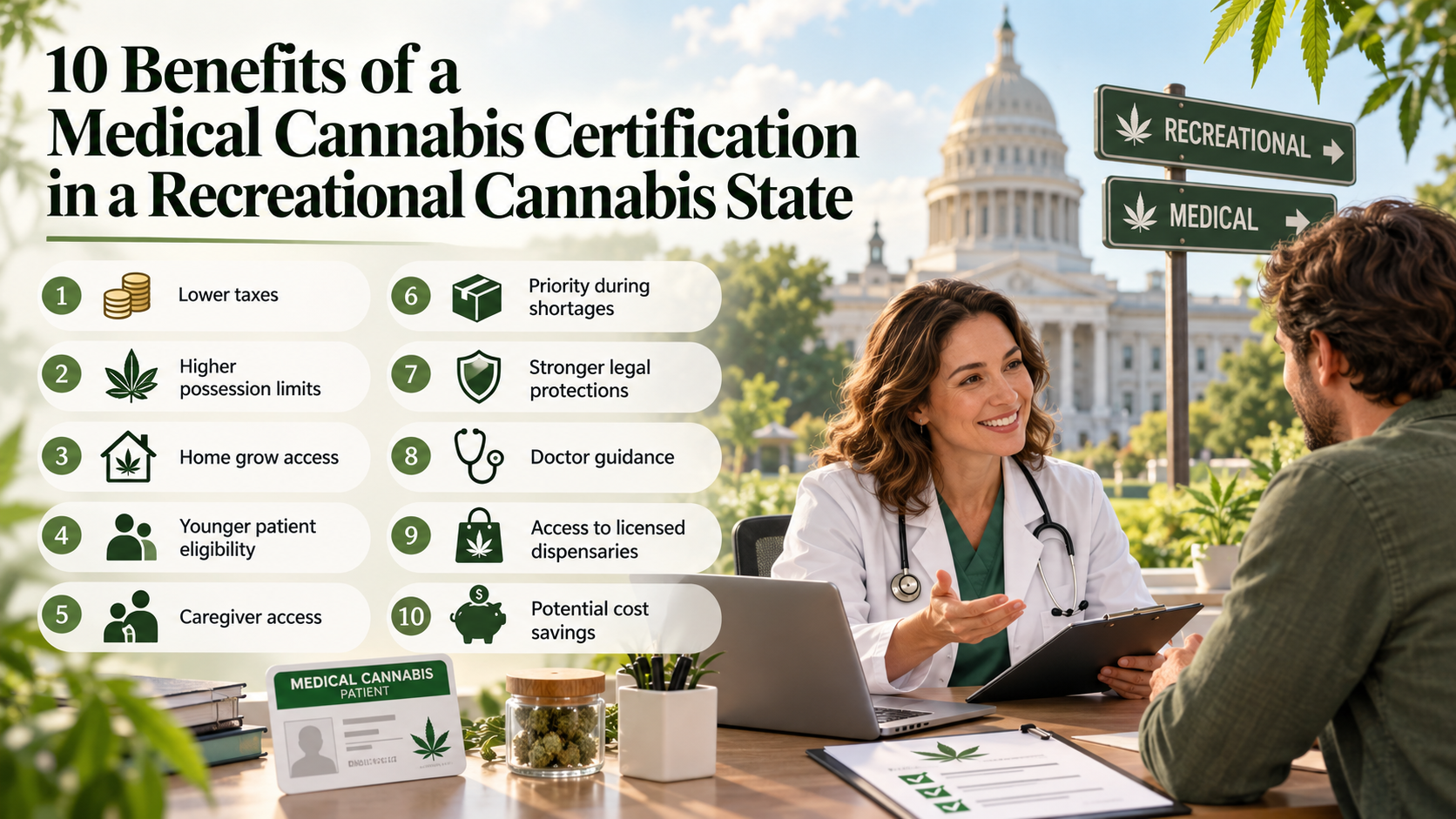
For most regular cannabis users, yes. Even where anyone 21+ can walk into a dispensary, a medical card usually means lower taxes, higher purchase limits, access at 18, and more legal protection. Here are the 10 biggest benefits of a medical card vs. recreational in 2026.
1. More legal protection
A state-issued medical card shows you’re using cannabis under a provider’s care. Depending on your state, that can mean added protection around possession limits, home growing, and some employment or housing situations. Protections vary widely, so check your state’s rules.
2. Products chosen for your condition
Recreational shopping often comes down to the highest THC. As a patient, you can work with your provider and dispensary staff to choose products by cannabinoid ratio, terpenes and dose for the symptoms you’re treating.
3. More expert support
Some states require medical dispensaries to have a pharmacist or medical professional available. Utah’s medical cannabis pharmacies, for example, are staffed by pharmacists who consult with patients.
4. Lower taxes
Medical patients pay less tax in nearly every state with both markets. In Illinois, patients pay 1% while recreational buyers pay a 10% to 25% cannabis tax plus sales tax. See medical marijuana taxes by state for what patients save in each state.
5. Higher purchase limits and home grow rights
Patients can usually buy and possess more. Illinois patients can buy about 2.5 ounces every 14 days, compared with 30 grams of flower for recreational buyers. Missouri patients can buy 6 ounces every 30 days, versus a 3-ounce recreational possession limit. Illinois also lets patients grow up to 5 plants at home, while recreational users can’t grow at all.
6. Patient discounts
Many dispensaries offer medical-only deals, loyalty programs and first-time patient discounts. Some CBD brands also offer discounts to registered patients.
7. Access where recreational stores are banned
Many cities and counties ban recreational dispensaries even in legal states. Hundreds of Michigan communities have opted out of recreational sales, and some Montana counties prohibit adult-use sales entirely. Medical dispensaries are often still allowed, giving patients more places to shop.
8. Buying when you travel
As of October 2026, about 21 states and territories let visiting patients buy at medical dispensaries with an out-of-state card, sometimes after a short registration. Never carry cannabis across state lines, though; that’s still illegal under federal law.
9. Access for patients under 21
Recreational stores only serve adults 21 and older. In most medical states, adults 18 to 20 can get their own card, and children with serious conditions like epilepsy can qualify with a parent or caregiver who registers and buys for them.
10. A plan you can track
Working with a provider helps you track which products, doses and timing actually help. Keep a simple log or use a tracking app, and bring it to your follow-up visits so your provider can adjust your plan.
Medical Card vs. Recreational at a Glance
| Comparison | Medical card | Recreational |
|---|---|---|
| Taxes | Lower, often none | Cannabis tax + sales tax + local tax |
| Minimum age | 18, or under 18 with a caregiver | 21 |
| Purchase and possession limits | Usually higher | Usually lower |
| Home grow | Allowed in more states | Limited or not allowed |
| Where you can shop | Medical dispensaries, including in towns that ban recreational stores | Only where local rules allow |
| Buying while traveling | Possible in about 21 states and territories | Only in recreational states |
| Provider guidance | Yes | No |
| Upfront cost | Certification + state fee | None |

FAQ
Why get a medical card if weed is legal in my state? You’ll usually pay less tax, buy more at once and get guidance from a provider. If you’re 18 to 20, a medical card may be the only way to buy legally.
Does a medical card pay for itself? For regular buyers, often within the first year. Someone spending $100 a month saves about $80 to $260 a year in most states with both markets. See the state-by-state savings breakdown.
Can I use my medical card in another state? In some. About 21 states and territories let visiting patients buy at medical dispensaries, often after a short registration. Check the rules before you travel, and never bring cannabis across state lines.
Can I own a gun with a medical card? Federal law treats cannabis users as prohibited from buying firearms, whether they have a medical card or buy recreationally. Talk to a lawyer if this affects you.
What happens to hemp THC products after Dec. 11, 2026? The federal hemp THC ban takes delta-8, THCA flower and similar products off store shelves. A medical card gives you a legal, lab-tested option at the lower patient tax rate.
Get Your Medical Cannabis Certification with CCA
Compassionate Clinics of America certifies patients in 27 states: Arizona, Arkansas, California, Connecticut, Delaware, Georgia, Illinois, Iowa, Louisiana, Maine, Maryland, Massachusetts, Michigan, Minnesota, Missouri, Montana, Nevada, New Jersey, New York, Ohio, Oklahoma, Pennsylvania, Texas, Utah, Vermont, Virginia and West Virginia. Book at mycompassionateclinic.com/get-a-card or call (888) 372-0325 to get certified or renew your card.
Sources
- Medical marijuana taxes by state (CCA) (tax rates and their sources)
- IDPH: Medical Cannabis Patient Program and Cultural Daily, May 2026 (Illinois limits, home grow, supply priority)
- Missouri DHSS: General FAQs (Missouri limits)
- Montana Dept. of Revenue: cannabis (counties that prohibit adult-use sales)
- Metro Times: Michigan communities banning marijuana shops
- The Marijuana Herald: states recognizing out-of-state cards (updated Oct. 11, 2026)
- FindLaw: California marijuana laws (medical access at 18, minors through a caregiver)